West Michigan’s leading business advocacy group becomes part of growing coalition supporting policies that create jobs and lower costs
Leading advocate for Great Lakes State hospitality joins call for policies that boost Michigan’s economy, welcome Canadian tourism
DETROIT — The Detroit Regional Chamber, one of the longest-running and largest business organizations in the United States, and its statewide MichAuto program, have joined the bipartisan Michigan Smart Trade Alliance (MISTA) to support its call for nonpartisan, smart and stable trade policies that help grow businesses and keep prices low for families. The Detroit Regional Chamber and MichAuto join MISTA’s growing roster of prominent business and policy groups representing regions across Michigan to call for Congress to support consistent and straightforward trade policies. The Detroit Regional Chamber has served Southeast Michigan for more than 100 years and advocates for economic development and public policy that supports job creation and prosperity for companies that range from startups to Fortune 500s. For over a decade its MichAuto program has served as the only statewide voice for the entire automotive industry and is designed to promote, grow, and retain Michigan’s automotive leadership. “Michigan is disproportionately vulnerable to fluctuating trade and tariff policy, particularly because our state sits along one of the busiest border crossings in North America and Canada is our largest trading partner,” said Sandy K. Baruah , president and CEO, for the Detroit Regional Chamber. “The businesses we represent are ready to grow, bring jobs, and create vibrant and stronger communities – but they need leadership and the space to discuss and advance consistent trade policy.” The Detroit Regional Chamber and MichAuto join a growing list of MISTA coalition members, including the Michigan Chamber of Commerce , Michigan Retailers , the Midwest Independent Retailers Association , the Michigan Osteopathic Association , the Lansing Regional Chamber of Commerce, the Midland Business Alliance and the Northern Michigan Chamber Alliance. The Detroit Regional Chamber and MichAuto recently partnered with the Michigan Chamber of Commerce to co-host the Michigan-Ontario Economic Leadership Roundtable featuring Canadian Minister Caroline Mulroney, president of the Ontario Treasury Board for a candid conversation on cross-border trade, supply chains, and North American competitiveness. “The Detroit Regional Chamber is a national influencer of economic policy, a voice for Michigan’s most important industries, and has one of the most respected advocacy shops in Lansing,” said John Sellek , a spokesman for the Michigan Smart Trade Alliance. “Few other business advocacy groups are better acquainted with Michigan’s vital trade relationship with Canada than the Detroit Regional Chamber, so we welcome them to the conversation.” The Chamber, and its statewide MichAuto program, has been an outspoken advocate for the importance of extending and strengthening the USMCA trade agreement, particularly to the automotive, manufacturing, agricultural, and tourism industries and their supporting supply chains. Its December Detroiter magazine featured business and political leaders on both sides of the border touting the importance of the U.S. and Michigan trade relationship with Canada. “Canada is not only our neighbor and friend, they are critical to our economy, past, present, and future,” said Glenn Stevens Jr. , executive director of MichAuto, and the chief automotive and innovation officer for the Chamber. “Together, Michigan and Ontario built our automotive industry over the past 120 years, and for us to thrive – we need to continue to strengthen that relationship. It continues to benefit people and businesses on both sides of the border.” MichAuto represents a sector that is crucial to Michigan’s economy, one that needs a predictable road map to protect jobs and plan future growth. The auto industry accounts for about 20% of Michigan jobs with a payroll of more than $80 billion and $348 billion in annual economic output, or about 27% of Michigan’s GDP. MichAuto is currently conducting a statewide industry roadmap focused on the forces of change that are redefining the automotive and mobility industry, with input from automotive companies, elected officials, and other industry stakeholders across the state. It also recently published the 2025 State of Automobility Report , outlining the strengths, weaknesses, challenges and opportunities facing Michigan’s signature industry amid unprecedented change. “The Detroit Regional Chamber and MichAuto are crucial voices for business in Michigan, and we are proud to have them join our coalition in calling for smart and stable trade policies,” said Mark Fisk , a spokesman for MISTA. “Manufacturers and business owners in Detroit and across Michigan need Congress to enact predictable trade policies that are good for families and our state’s economy.”

Former Under Secretary of Commerce for International Trade highlights harm to Michigan industries under current trade policies
Message on airplane banner by Michigan Smart Trade Alliance notes need for change in trade policies that work for Michigan businesses, farmers and families

Michigan has always been a state that makes and grows things to sell to the world. That is precisely why smart, consistent trade policy matters so much here at home. The recent Supreme Court decision limiting the use of emergency powers to impose tariffs only makes the role of Congress clearer. Lawmakers must take the lead on trade policy that creates jobs, lowers costs for families and protects our vital relationship with Canada. The Michigan Smart Trade Alliance (MISTA) is a growing, nonpartisan coalition of Michiganians focused on advocating for trade policies that strengthen national security while allowing both our state and national economy to flourish. Strategic trade tools play an important role, but for the Great Lakes State that is deeply integrated with Canada, the unpredictable on-again, off-again tariffs create uncertainty that is harming our workers, businesses and families. Our coalition continues to grow . Six respected statewide and regional groups that represent small businesses, health care organizations and manufacturers have already joined our coalition, with more to come. As Bill Hallan, CEO of Michigan Retailers, put it: “To thrive in our global economy, retailers and small businesses need consistency and predictability.” Read more at: www.detroitnews.com

The state’s leading business advocacy organization joins growing number of groups supporting consistent, durable trade policy

Tariffs on lumber, steel, other materials hike already high cost of housing for Michigan families
Order to government to issue refunds following SCOTUS ruling highlights the need for smart and consistent trade policy

The Michigan Smart Trade Alliance is calling for predictable trade policy that grows Michigan jobs, lowers costs for families and protects our relationship with Canada Michigan Smart Trade Alliance campaign highlights economic impact of tariffs, calls for predictable trade policies that lower costs and support Michigan jobs
The Michigan Smart Trade Alliance is calling for predictable trade policy that grows Michigan jobs, lowers costs for families and protects our relationship with Canada
New nonpartisan coalition says high court decision means time is now for Michiganders to call for smart, consistent trade policy
Groups representing businesses, retailers join the Michigan Smart Trade Alliance to showcase importance of effective trade, tariff policies
The Michigan Smart Trade Alliance says congressional debate over Canadian tariffs is an opportunity to rebalance the discussion around smart trade policy

Michigan Smart Trade Alliance highlights need to keep goods moving, reduce costs, provide consistency for state industries
As tariffs squeeze Michigan farmers, new nonpartisan group focuses on creating space to promote smart, consistent trade policies

Michigan — not Canada — hurt by tariffs that drive up costs, cripple competition
Michigan Smart Trade Alliance: 100% tariffs on Canada would damage Michigan’s economy

MISTA welcomes the Midland Business Alliance to our coalition! Together, we are seeking a nonpartisan discussion on the need for consistent trade policy that creates Michigan jobs, lowers costs for businesses and families, and protects our trading relationship with Canada. As Midland Business Alliance President & CEO Tony Stamas noted: “We support MISTA’s effort to foster a constructive dialogue on consistent trade and tariff policies, recognizing the vital role these policies play in Midland’s economy and the broader Great Lakes Bay Region.” — Tony Stamas, President & CEO, Midland Business Alliance Join us in working for smart, fair, consistent trade today!
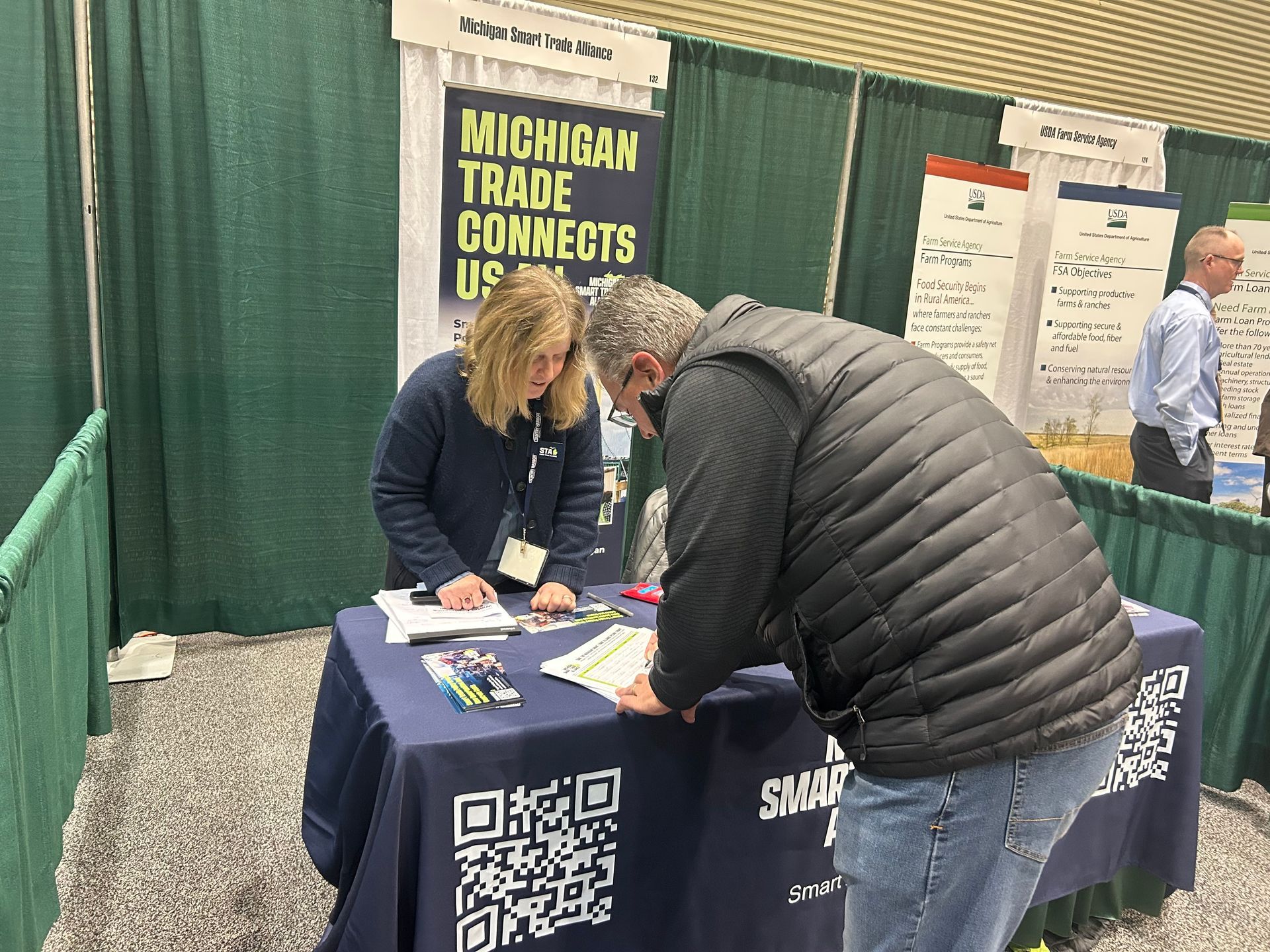
Michigan Agri-Business Association Winter Conference & Trade Show
Bipartisan poll indicates Michigan residents are concerned about costs, watching trade issues, and opposing tariffs Lansing, Mich. — The Michigan Smart Trade Alliance (MISTA), a new non-partisan statewide public policy organization, announced today that it will lead an education effort in support of Michigan families and small businesses seeking smart, consistent trade policies. MISTA’s mission is to encourage thoughtful discussion about trade policy, including tariffs, that affect the entirety of our great state’s economy. Leveraging insights from Michigan public policy professionals with decades of experience on state legislative and regulatory matters, MISTA will elevate the voices of Michigan business and industry, including autos, agriculture, tourism, retail, restaurants, hospitality, manufacturing and more. Over the coming months, MISTA will focus on growing its coalition by providing opportunities where both trade and tariff education and discussion can take place. Where Michigan stands on trade and tariffs Among the MISTA’s first initiatives is a study of consumer sentiment in Michigan on key trade-related topics, including tariffs and their effects on family and business budgets. MISTA recently commissioned a statewide poll of 600 registered Michigan voters focused on U.S. trade policy and tariffs, conducted by a respected, bipartisan team of national pollsters from UpONE Insights (R) and Impact Research (D). “Our poll confirmed that Michiganders across party lines are struggling with affordability issues and, understandably, are not wild about policies that can cause higher prices,” said John Sellek, Chief Strategist and CEO, Harbor Strategy Public Affairs. “They know we must reduce our reliance on foreign suppliers through smart trade deals, but in ways that reduce the pressures of everyday costs, support Michigan’s diverse economy, and protect critical trading relationships, like the one our auto industry has with Canada.” “Instead of the usual zero-sum political battles that define politics today, MISTA will seek a bipartisan coalition of small businesses and families to come together in discussion about the difficulties they are facing, and the best path forward on trade policy,” said Mark Fisk, Partner/CEO, Byrum & Fisk Advocacy Communications. “Michigan’s leaders must not treat our economic future like a partisan football game.” Concerned about costs, watching trade issues, opposing tariffs MISTA’s bipartisan poll shows overall that costs and affordability are very concerning to Michigan residents. As such, state residents overall oppose trade policies that result in additional price increases, including tariffs. The poll indicates that the strongest messages opposing tariffs directly touch on voters’ concerns about cost increases hurting their quality of life and the negative impact of tariffs on Michigan’s relationship with its largest trading partner, Canada. Whereas the most effective messages in support of tariffs are focused on America’s need to reduce foreign reliance and level the playing field against countries like China. Solutions to limiting costs and fairer trade deals lies within those parameters. Costs and affordability dominate the state’s issue agenda · Reducing costs is by far the most important issue to voters, with the economy and jobs the 2 nd most important. Only 16% said their personal financial situation is improving. Voters are watching tariff and trade issues… · More than 80% have heard about U.S. tariff policy discussions, across the political spectrum. · Nearly 70% say they understand tariff policy to some extent …and they oppose tariffs · Michigan voters oppose tariffs on imports by six points, 43% support-49% oppose o Independents – 50% oppose o Seniors – 52% oppose o Suburban voters – 51% oppose o Moderate voters – 54% oppose o College degree – 53% oppose o Without a degree – 47% Voters overwhelmingly oppose tariffs that hurt the state’s auto industry, including tariffs on parts crossing the U.S. – Canadian border · Voters oppose imposing tariffs on auto and manufacturing parts by a 29-point margin, 31% support-60% oppose. Michigan voters see tariffs as a tax… · 72% of voters think tariffs are “a tax on goods imported into the United States”, with little difference between Republicans, Independents and Democrats. · 13% said tariffs are a negotiating tool. …that is paid by Michigan families · Nearly two-thirds (64%) believe “American consumers” pay most of the cost of imposing tariffs, including a majority of GOP and Trump voters and Trump voters Learn more about Michigan Smart Trade Alliance Michigan residents and small businesses can join Michigan’s Smart Trade Alliance, a non-partisan coalition elevating the voices of families, farmers, job creators, and entrepreneurs who are seeking consistent trade and tariff policy that focuses on: · Protecting our national security interests · Bringing leaders together to discuss updating existing trade deals and open new markets for our farmers and manufacturers · Lowering costs across the board by implementing tariff consistency · Protecting our critical trading and tourism relationship with Canada

Key Findings: